
On April 9, the Business School of Beijing Technology and Business University successfully hosted the first edition of the 2024 Logistics and Supply Chain Management Frontier Forum. The event featured a keynote lecture by Professor Francisco Saldanha da Gama from the School of Management at the University of Sheffield, UK, who delivered an academic presentation entitled “The Latency Location-Routing Problem with Stochastic Travel Times” to faculty members and students.
The forum focused on the latest research advancements and frontier developments in the field of logistics and supply chain management. Professor Cui Li, Director of the Department of Digital Operations at the Business School, chaired the event. Associate Directors Zhu Yuting and Yan Ke, along with other core faculty members, doctoral and master’s students, as well as a number of external faculty and students, attended the forum.
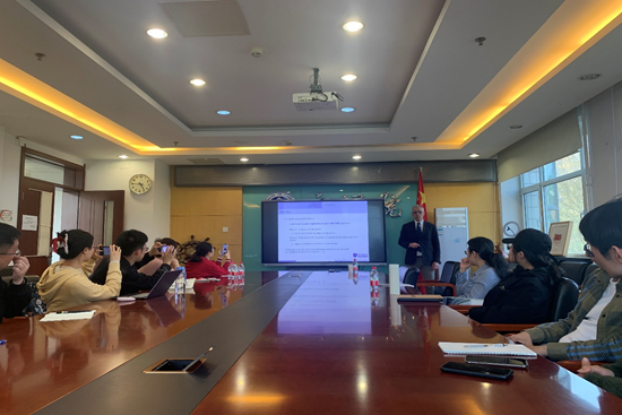
Profesor Cui Li first delivered a warm welcome to Professor Francisco Saldanha da Gama and emphasized that the forum holds significant value in advancing the academic standards of the School in the field of logistics and supply chain management.
Subsequently, Professor Francisco Saldanha da Gama delivered a comprehensive and in-depth analysis of the facility location problem, drawing on his extensive expertise and insightful perspectives. He began by outlining the research background, highlighting the growing significance and inherent complexity of facility location in contemporary society. In light of the rapid advancement of globalization and urbanization, facility location has evolved beyond a mere geographical decision-making process, emerging as a multidimensional challenge that encompasses economic, social, and environmental considerations.He then highlighted the critical role of model formulation in solving complex logistical problems and introduced several widely used modeling approaches. These approaches involve incorporating key factors such as geographical location, traffic conditions, and population distribution, along with methodologies for quantifying these variables and integrating them into analytical models. Through detailed case studies and comparative analyses, he demonstrated how different model formulations influence final outcomes, thereby enhancing participants’ understanding of the underlying complexities. Furthermore, he noted that while exact algorithms are capable of yielding optimal solutions, they entail high computational complexity and are therefore best suited to small-scale problems or those requiring high precision. In contrast, heuristic algorithms can efficiently produce near-optimal solutions within a significantly shorter time frame, making them more appropriate for large-scale or real-time applications. Through a comparative analysis of algorithmic applications in facility location problems, participants gained a clearer understanding of the distinct characteristics and respective application domains of these two approaches.
Following the conclusion of the forum, participating faculty members, doctoral students, and Professor Francisco Saldanha da Gama engaged in a dynamic and substantive discussion. With regard to model construction, attendees offered their perspectives and recommendations on effectively integrating real-world factors into modeling frameworks, as well as enhancing model accuracy and practical applicability. Professor Francisco Saldanha da Gama patiently addressed participants’ inquiries and shared valuable insights and personal experiences from his extensive work in the field.
Regarding academic writing and manuscript submission, Professor Francisco Saldanha da Gama offered highly valuable guidance. He underscored the importance of topic novelty, methodological innovation, and analytical rigor—key determinants of high-quality scholarly work. He also shared practical insights and strategies from his extensive experience in research publication, including how to select appropriate target journals and how to craft compelling abstracts and conclusions. Furthermore, he emphasized that journal selection plays a critical role in both publication success and academic impact. Therefore, prior to submission, authors should thoroughly assess a journal’s scope, peer review timeline, and acceptance criteria to ensure alignment with their research and maximize the likelihood of successful publication.
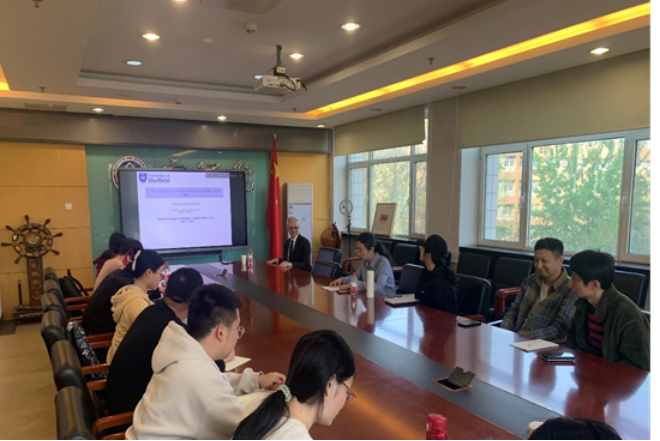
This forum served as a valuable platform for participants to exchange scholarly ideas and share research outcomes, enabling attendees to gain a deeper appreciation of the intellectual rigor and academic significance of research. It also highlighted the business school’s academic expertise in the field of logistics and supply chain management, providing faculty and students with an internationally aligned forum for academic engagement and contributing to the sustained advancement of the school in this domain. Going forward, the business school will continue to organize high-quality academic events of a similar nature, fostering enhanced opportunities for learning, collaboration, and scholarly exchange.