
The Business School of Beijing Technology and Business University traces its origins to the Central Cooperative Administration Cadre School, established in 1950, and the Central Commercial Cadre School, founded in 1953. Over time, it has integrated key academic units from the former Beijing Business School—including the Department of Accounting, the Department of Storage and Transportation, the Department of Management, and the Department of Catering and Tourism—as well as relevant programs from the former Beijing Institute of Light Industry’s Department of Management. Through 75 years of continuous development and institutional evolution, the school has cultivated a significant number of high-caliber professionals who have made notable contributions to China’s business and management sectors.
Recently, Professor He Yurun, Dean of the Business School of Beijing Technology and Business University, was invited for an exclusive interview with this program. She shared insights into her transition from an academic scholar to an educational leader, and elaborated on how the Business School advances the “Integration of Business and Industry” as a core philosophy to address contemporary challenges and cultivate interdisciplinary business leaders capable of driving future industrial innovation and growth.
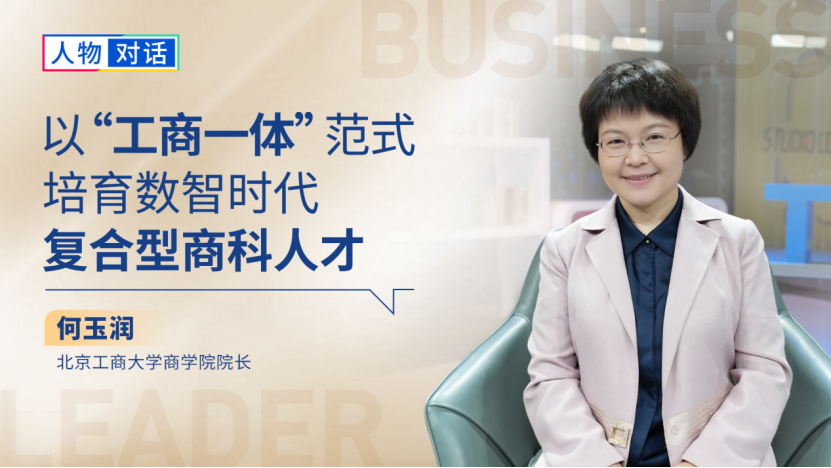
From Depth to Breadth: The Challenges and Restructuring of the Managerial Role
Transitioning from academic scholarship to leading a business school, Dean He Yurun candidly described her experience as a shift “from depth to breadth.” She noted that, unlike scholars whose work centers on specialized research, academic leaders must oversee a broad range of responsibilities—including faculty development, teaching quality assurance, student career outcomes, resource mobilization, and institutional branding. At the heart of effective management, she emphasized, lies the ability to balance competing priorities, coordinate across stakeholders, and communicate strategically. In the context of the digital economy, she further stressed that business school leaders must adopt forward-looking strategies to align institutional development with long-term sustainability and evolving industry demands.
The emergence of new-quality productive forces has catalyzed a profound transformation in business education, bringing both significant challenges and strategic opportunities.
In response to emerging economic paradigms such as the digital economy and platform economy, Dean He Yurun highlighted three core challenges currently facing business education. First, curricular frameworks remain misaligned with evolving industry needs. Traditional programs often lack sufficient integration of frontier technologies—such as big data analytics and artificial intelligence—and fail to adequately develop students’ understanding and application capabilities in strategic emerging industries. Moreover, there is an urgent need for faculty who possess both deep business acumen and advanced digital literacy. Second, evaluation mechanisms lag behind contemporary demands. While practical innovation and industry-academia collaboration are critical drivers of advancement in business education, prevailing assessment systems continue to prioritize theoretical research over applied outcomes, thereby constraining collaborative innovation. Third, international adaptability remains insufficient. Amid shifting global industrial chains, talent development must dynamically incorporate cross-disciplinary knowledge—including geopolitics and green economy principles—to meet the complexities of today’s interconnected world.
“Challenges also represent opportunities for transformation,” noted Dean He. She proposed a comprehensive strategy to address these issues: strengthening industry-university-research collaboration through sustainable resource-sharing mechanisms; advancing dual-competency talent development centered on the integration of technology and business by incorporating blockchain and cloud computing into core curricula; establishing a multidimensional evaluation system to empower faculty innovation; and leveraging global competence as a strategic lever to fully harness the potential of new-quality productive forces.
Integration of Business and Industry: Building the Most Grounded Business School
The Integration of Business and Industry represents Beijing Technology and Business University’s strategic response to national development imperatives and evolving industrial demands, grounded in its distinctive institutional heritage. Centered on the core principles of integration, empowerment, cross-disciplinary collaboration, and symbiosis, this initiative leverages the university’s unique “industry + commerce” legacy—originating from the merger of institutions such as Beijing Light Industry College and Beijing Business School. Through six strategic pathways—restructuring disciplinary frameworks, rebuilding innovation systems, transforming talent cultivation models, elevating service capabilities, strengthening faculty teams, and innovating governance mechanisms—the university aims to establish a distinctive Chinese model of business-industry convergence underpinned by an independent knowledge system.
“Our ultimate goal is to cultivate new-generation business professionals equipped with engineering thinking and systems logic, as well as emerging engineers who possess strong business acumen,” stated Dean He Yurun. In alignment with the national innovation-driven development strategy, Beijing’s positioning as a global hub for digital economy and international consumption center, and the broader wave of digital transformation, the Business School is actively advancing the “Integration of Business and Industry” paradigm. By anchoring development in consumer-centric industries, the school is reshaping the New Business Education framework to better serve urban and industrial transformation.
“Going forward, our Business School will focus on cultivating business leaders and management elites deeply versed in the light industry and food sectors—industries that are fundamental to people’s everyday lives, encompassing clothing, food, housing, and transportation. This deep societal connection defines us as the ‘most grounded business school,’ a distinguishing feature and competitive advantage that sets us apart from peer institutions.”
Deep Integration of Industry and Education: Innovative Practices from Curriculum to Institutional Design
To realize the talent development goal of “technological proficiency and managerial excellence,” Beijing Technology and Business University has established deep strategic partnerships with leading enterprises such as BOE and JD.com. Through systematic institutional innovation, the university has built a mutually reinforcing ecosystem that aligns the education chain with the industrial chain, enabling bidirectional value creation.
Dean He Yurun emphasized that this transformative initiative is manifested across multiple dimensions—joint program development, co-designed curricula, shared platforms, and integrated faculty resources. By closely aligning with evolving industrial trends and societal needs, the model transcends traditional disciplinary boundaries and fosters seamless integration between academic training and industry requirements, ensuring that graduates are well-prepared to meet the demands of emerging sectors.
For example, in faculty development, the university has strengthened dynamic alignment between teaching staff and curriculum evolution by establishing an integrated tripartite ecosystem comprising “faculty mobility stations,” “enterprise training bases,” and “joint laboratories.” The implementation of a dual-mentor system—featuring rotating faculty placements in enterprises and on-campus instruction by enterprise experts—accelerates knowledge updating and enhances practical relevance.
In pedagogical practice, the proportion of enterprise mentors participating in classroom teaching has been significantly increased. A structured experiential learning framework—encompassing cognitive internships, in-class experiments, on-the-job training, and industry-linked graduation projects—ensures students engage with real-world challenges from the outset of their studies. Graduation designs are directly oriented toward solving pressing industry problems. Furthermore, comprehensive bases that integrate training, production, and R&D functions have been developed to enable close alignment between instructional processes and actual production workflows.
Rooted in Chinese Practice, Advancing Toward World-Class Excellence, and Driving Industry Progress
In discussing the Business School’s strategic vision, Dean He Yurun highlighted two key priorities: deepening industry-academia integration in the light industry and food sectors through the development of standardized corpora based on real-world application scenarios; and leveraging international business education accreditation as a catalyst to comprehensively enhance students’ capabilities in navigating global industrial transformation.
Addressing prospective MBA candidates for the 2026 intake, Dean He emphasized that the program will continue to uphold the principle of “merit-based selection,” offering high-value education supported by a comprehensive, multi-tiered scholarship system. She encouraged applicants with the following message: “Prepare diligently, maintain a calm mindset, and have confidence in your potential.”
In closing the interview, Dean He extended a heartfelt invitation to future business leaders: “By joining the MBA program at Beijing Technology and Business University, you will gain access to a personalized curriculum, mentorship from leading industry practitioners, and hands-on competencies essential for shaping the future.” She expressed her aspiration to cultivate a new generation of talent—equipped to become the backbone force driving new-quality productive forces—within the innovative ecosystem of “Business-Industry Integration” at Beijing Technology and Business University.